

Neck pain has a way of colouring everything else in your day. Checking your blind spot in the car becomes a whole-body manoeuvre instead of a quick glance. A long day at a screen finishes with a dull ache that creeps into a headache by evening. Sleep becomes a search for the one pillow height that doesn't leave you stiff the next morning. It's one of the most common reasons people come to see us, and one of the most disruptive, simply because the neck is involved in almost everything you do.
At Thrive Physiotherapy in Erina, we see neck pain in office workers whose long hours at a desk have caught up with them, tradies managing years of looking up or working in awkward positions, people recovering from a car accident, parents whose neck has locked up seemingly out of nowhere, and anyone whose headaches seem to be coming from somewhere other than their head. Whatever brought you in, the approach is the same: work out exactly what's driving your pain, and build a realistic plan around it.
Neck pain is also an area where a lot of unhelpful myths circulate — that a stiff neck means something is out of place, or that persistent pain automatically means significant damage. Scans of the neck very often show findings that sound concerning but are extremely common in people with no pain at all, and the large majority of neck pain, even neck pain with headaches or arm symptoms, improves significantly with the right guidance and doesn't need imaging or invasive treatment.
Some necks need a handful of sessions and a solid strengthening program to get back on track. Others, particularly nerve-related presentations or longer-standing pain, need a more structured, longer-term process. Either way, you'll leave your first appointment with a clear working diagnosis and a genuine plan, not just a name for your pain and a vague instruction to rest.
Cervical Spine (Neck) Physiotherapy Erina & Central Coast
Understanding Your Cervical Spine
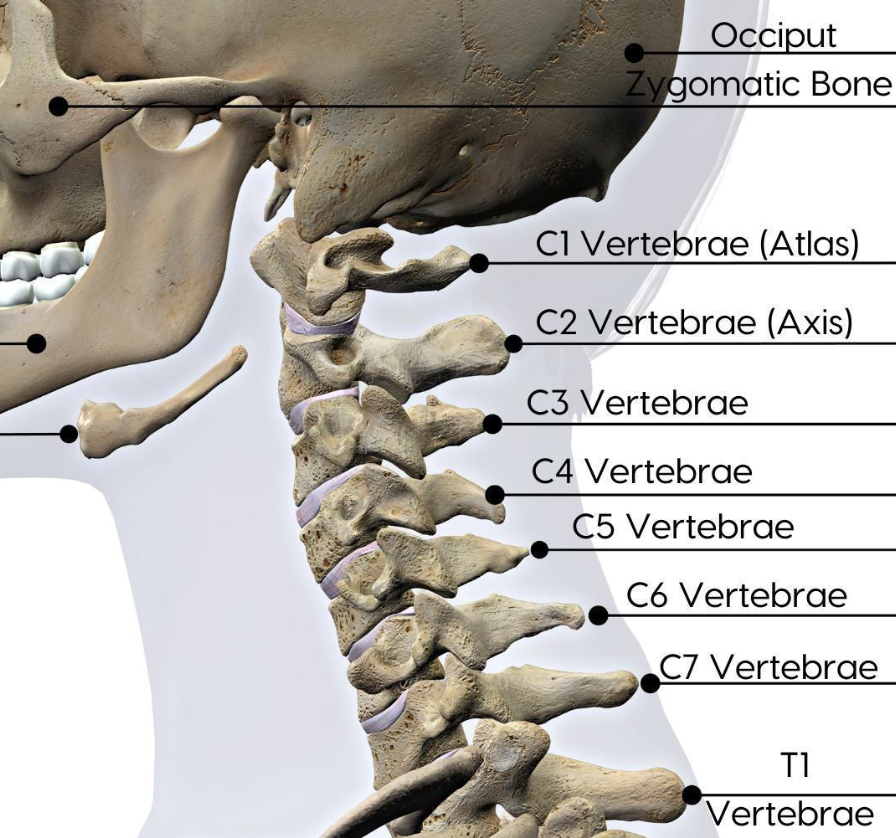
Your cervical spine is made up of seven vertebrae, stacked from the base of your skull down to your upper back, with a cushioning disc between most levels acting as a shock absorber. Behind each disc sit a pair of facet joints, small joints that guide and limit how far your neck can bend, extend, rotate, and tilt. Nerves exit the spine at each level and travel down into your shoulders and arms, which is why problems in the neck can sometimes cause symptoms felt well away from the neck itself. The top two vertebrae, just below the skull, have a slightly different structure to the rest of the cervical spine and are responsible for a large proportion of your neck's rotation — turning your head to check over your shoulder relies heavily on this upper section. The neck is also surrounded and supported by a deep layer of stabilising muscles, along with larger, more familiar muscles like the upper trapezius, which often becomes a focal point of tension and discomfort even when it isn't the true underlying source of the problem.
Common Cervical Spine Conditions We Treat
Neck pain can come from several different structures, and it's common for more than one to be contributing at once. Here are six of the conditions we see most often at our Erina clinic.
Non-Specific Neck Pain
The most common type of neck pain we see — pain without one single, clearly identifiable structural cause, usually related to a combination of muscle guarding, joint stiffness, and reduced load tolerance rather than any one damaged structure. It often builds gradually from a mix of prolonged desk postures, stress, and reduced general activity, or follows a specific awkward movement or sleeping position. Despite the name sounding vague, it responds very well to the right movement-based treatment, and most people are surprised at how much a properly targeted strengthening program improves their symptoms.
Learn more: Non-Specific Neck Pain →
Cervicogenic Headache
A headache that originates from the neck, most commonly the upper cervical joints and surrounding muscles, rather than from within the head itself. It typically causes a one-sided headache that starts at the base of the skull and spreads toward the forehead or behind the eye, often worsened by specific neck movements or sustained postures, such as long periods at a desk. It's frequently mistaken for a tension headache or migraine, which is part of why an accurate diagnosis matters so much for getting the right treatment underway.
Learn more: Cervicogenic Headache →
Whiplash-Associated Disorder (WAD)
A collection of symptoms following a sudden acceleration-deceleration injury to the neck, most commonly from a car accident. It can involve the joints, muscles, ligaments, and sometimes the nerves of the neck, and symptoms can range from mild stiffness through to significant pain, headaches, and reduced range of movement that takes longer to settle. Early, guided movement and reassurance generally lead to better outcomes than prolonged rest or a neck collar.
Learn more: Whiplash-Associated Disorder (WAD) →
Cervical Radiculopathy
Pain, numbness, or tingling that travels into the shoulder, arm, or hand, caused by irritation or compression of a nerve root in the neck, often related to a disc bulge or degenerative changes pressing on or irritating the nerve. It's the neck's equivalent of sciatica in the lower back, and can range from a mild, intermittent ache to significant arm pain that outweighs the neck pain itself. The large majority of cases improve significantly with the right conservative management, and surgery is only needed in a small minority.
Learn more: Cervical Radiculopathy →
Cervical Facet Joint Pain
The small facet joints that guide movement at each level of your neck can become irritated or inflamed, often from repetitive extension or rotation, or following a specific awkward movement like sleeping in an unusual position. Facet joint pain tends to be felt close to the spine and can sometimes refer pain into the shoulder or upper back, which occasionally leads to confusion with other causes of neck and shoulder pain, even though the underlying mechanism is quite different.
Learn more: Cervical Facet Joint Pain →
Wry Neck (Torticollis)
A sudden, often alarming locking of the neck, typically noticed first thing in the morning, where the neck becomes stuck in a tilted or rotated position with significant pain trying to move out of it. It's more common in younger adults, and while it can feel dramatic — people are often quite distressed when they can't turn their head at all — it usually responds quickly to the right hands-on treatment and settles within days to a couple of weeks.
Learn more: Wry Neck (Torticollis) →
Common Cervical Spine Symptoms
People describe neck pain in all sorts of ways, and the specific pattern of symptoms often gives us useful clues before we've even started the physical assessment. It's rarely just ‘my neck hurts’ — it's usually a fairly specific combination of the following:
A dull ache or sharp pain in the neck, sometimes worse with specific movements
Headaches that seem to start at the base of the skull
Pain, numbness, or tingling travelling into the shoulder, arm, or hand
Stiffness that's worse first thing in the morning or after prolonged sitting
A sudden inability to turn or tilt your head normally
Pain that radiates into the upper back or between the shoulder blades
Difficulty finding a comfortable position to sleep in
Pain that started after a car accident, a fall, or a specific awkward movement
A feeling of tightness or tension through the shoulders and upper back
You don't need to know exactly which structure is involved before booking in — that's exactly what your assessment is for. But if any of the above sounds familiar, particularly if you're noticing arm symptoms alongside your neck pain, it's worth getting a proper assessment rather than just waiting to see what happens.
Because the upper neck sits so close to the base of the skull, irritation here can refer pain into the head, producing headaches that feel like they're coming from behind the eyes or across the temple, even though the true source is further down in the neck. This connection between the neck and headaches is one of the more under-recognised but genuinely common patterns we see.
It's worth saying clearly: the neck is a strong, resilient structure, built to support and move your head through an enormous range of positions many thousands of times a day. Persistent pain doesn't usually mean something fragile or damaged beyond repair — far more often it reflects a system that's become sensitised, deconditioned, or simply hasn't had the right rehab yet.
This distinction matters clinically as much as it matters for peace of mind. A neck that's sore because it's deconditioned and guarded needs a very different approach to one with a genuine nerve compression, and part of our job in your first session is working out which situation you're actually in, rather than assuming the worst from a scan report or a well-meaning friend's story about their own neck problems.
How We Assess Neck Pain
Your first appointment starts with a thorough conversation about how your pain started, what makes it better or worse, and what it's stopping you from doing. We'll also ask specific screening questions to rule out anything that needs more urgent medical attention, which is standard practice for any neck assessment and nothing to be concerned about — it's simply good, thorough clinical practice, particularly for the neck given its proximity to important structures.
From there, we move into a hands-on assessment of your neck's movement, strength, and specific neurological tests if there's any suggestion of nerve involvement, such as arm symptoms. This helps us build an accurate picture of which structures are likely contributing to your pain and how irritable things currently are, which shapes exactly how we approach the early stages of your treatment.
In most cases, imaging isn't needed. The vast majority of neck pain can be assessed and managed clinically, and imaging findings often don't correlate well with pain — disc bulges and degenerative changes are extremely common in people with no neck pain at all. We reserve imaging for cases with red flag features, significant or progressive neurological symptoms, or when recovery isn't progressing as expected.
By the end of your first session, you'll have a working diagnosis, a clear explanation of what's likely driving your symptoms, and a first set of exercises or advice to start on straight away — not just a name for your pain and a vague instruction to rest and see how it goes.

How Physiotherapy Helps
Treatment is built around what's actually driving your pain, not a generic ‘neck pain protocol’. This typically includes hands-on treatment to ease pain and improve movement in the early stages, combined with a progressive strengthening program targeting your deep neck flexors and postural muscles. For nerve-related pain like radiculopathy, we'll also use specific techniques to reduce nerve irritation and guide safe movement while things settle.
Education is a genuinely important part of treatment for the neck, since fear of movement and unnecessary activity avoidance are two of the most common reasons neck pain becomes prolonged. We'll help you understand what's safe, what to expect, and how to adjust your work setup, sleeping position, and daily habits to support your recovery.
For more persistent or complex presentations, such as significant whiplash-associated disorder or longstanding radiculopathy, we'll build a longer-term management plan and, where appropriate, coordinate with your GP or a specialist so everyone involved in your care is working from the same picture.
Cervical Spine Recovery Timeframes
Every neck is different, but these general ranges give you a rough idea of what to expect. Your physiotherapist will give you a more accurate timeframe once we understand your specific diagnosis.
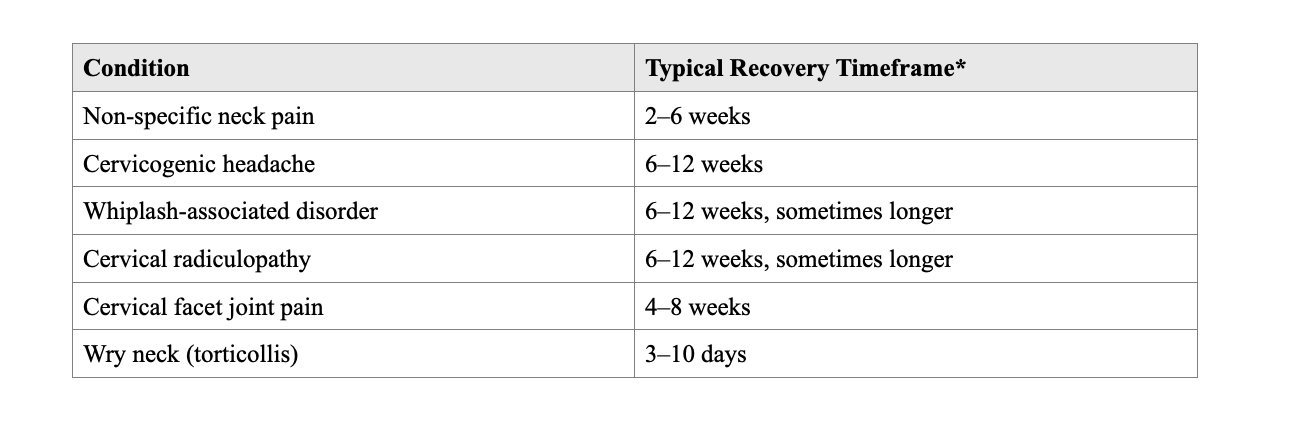
IIf your recovery looks like it's tracking outside these ranges — either much faster or much slower — that's useful information too, and something we'll factor into your ongoing plan rather than sticking rigidly to a generic timeline.
Preventing Neck Pain From Coming Back
Once your neck has settled, the priority shifts to keeping it that way. Ongoing strength in your deep neck flexors and postural muscles is one of the best-supported ways to reduce the risk of a repeat flare-up, along with regular movement breaks if your work involves long periods at a desk or screen.
For office-based workers, small changes to workstation setup, screen height, and regular posture breaks can make a genuine difference over months and years of cumulative load. For anyone managing stress-related tension through the neck and shoulders, addressing this alongside the physical strengthening tends to produce more lasting results than either approach alone.
We'll talk you through exactly what an ongoing maintenance plan looks like for your specific neck and lifestyle before you finish your course of treatment, so you're not left guessing about what to keep doing once regular sessions wrap up.
Why Choose Thrive Physiotherapy
We're a local team based right here in Erina, and neck pain is one of the conditions we treat most often. We take the time to explain what's actually going on with your neck in plain language, correct the myths that so often make neck pain feel scarier than it needs to be, and build a plan around your goals rather than a generic handout.
Whether your neck pain is brand new or something you've been managing around for years, our approach stays the same: a proper assessment, an honest explanation, and a plan that's realistic for your life — not just an idealised version of it. If something isn't improving the way we expected, we'll say so and adjust the plan rather than quietly continuing on regardless.
We also keep a close eye on the things that get missed elsewhere — how your upper back and shoulders are moving, whether your postural muscles are doing their share of the work, and whether stress or sleep is playing a role in how your neck is feeling day to day. Necks rarely operate in isolation, and treating the whole picture is usually what separates a quick fix from a lasting one.
Frequently Asked Questions
Do I need a referral to see a physiotherapist for neck pain?
No, you can book directly with us. If you're being treated under a specific plan such as an EPC, CTP, or WorkCover claim following an accident, bring any paperwork along and we'll help you sort out the details.
Will I need a scan for my neck pain?
Usually not. Most neck pain can be diagnosed and managed clinically, and imaging is reserved for cases with specific red flag features or where recovery isn't progressing as expected.
I've been told I have degenerative changes in my neck — does that mean I need surgery?
Not necessarily, and often not at all. Degenerative changes are extremely common, including in people with no pain, and the large majority of neck pain improves significantly with conservative management.
Can a physiotherapist help with headaches?
Yes, particularly headaches originating from the neck. We'll assess whether your headaches have a cervicogenic component and treat accordingly if so.
How many sessions will I need?
It depends entirely on the condition and how long it's been going on. Some necks settle in a handful of sessions; others, particularly nerve-related or whiplash-related presentations, need a longer-term plan. We'll give you an honest estimate after your first visit.
Is it safe to have my neck treated after a car accident?
Yes, once serious injury has been appropriately screened for, physiotherapy is a standard and effective part of whiplash management, and early, guided movement generally leads to better outcomes than prolonged rest or immobilisation.
Can stress make my neck pain worse?
Yes, stress and tension commonly contribute to neck and shoulder tightness, and addressing this alongside the physical aspects of your treatment often produces better, more lasting results.
What if my neck pain has been going on for months, or even years?
Long-standing neck pain is still very treatable. It often responds well once the right diagnosis and strengthening plan are in place, though it may take a bit longer to settle than a recent injury, and we'll be upfront with you about that from the start.
Book Your Cervical Spine Assessment
If neck pain is getting in the way of work, sleep, or the things you enjoy, don't wait for it to get worse. The longer it's left unaddressed, particularly with any nerve involvement, the more it tends to affect strength and confidence in movement, which can make recovery slower than it needed to be.
Book an appointment with our Erina team and let's work out exactly what's going on — and what to do about it. Most people are relieved to finally have a clear explanation, rather than continuing to guess at what's wrong and hoping it settles on its own.